Thinking about authentication

Five years ago I blogged some thoughts on authentication and how confusing it is.  I thought it might be interesting to revisit this in the light of the recent report sponsored by OpenAthens on “Librarians’ experiences and perceptions of Identity and Access Management”. I also had a long chat with Phil Leahy at UKSG which is always a pleasure.

I broadly agree with the report – everyone wants things to be seamless, no one wants to login, no one wants to understand technical matters / terms.  From my NHS perspective we have pretty much always needed to treat everyone as “offsite” as IP access is rarely an option.  Perhaps the increasing demand evidenced in the wider community will drive some neat solutions?

Challenges of offsite access

I thought it interesting that the library staff felt that offsite access was a bigger challenge to their skills and knowledge than to that of the users and their increasingly complex journeys.  We spend a lot more time worrying about these things than the users! I would expect a somewhat different result if users were asked.

In the solutions section I was excited to see the potential discussed for recognising multiple affiliations – this would be a real game changer (alongside some licence work).  Increased granularity is something we can see coming in the changes to NHS OpenAthens but this needs to be accompanied by changes to allow automated allocation to different permission sets by user type.

In terms of my thoughts from five years ago – how have we done?

Many of the issues remain the same and are tied up in the nature of authentication – people do need to identify themselves and remember their login details.

The change to a two step authentication has been accepted by the users and meets the need to increase control over potential dubious registrations.

Problems with over convoluted login paths remain (and remain within the remit of the publishers who should be doing better) as does inconsistent use of terminology.

A new problem comes from the stricter password rules which place a higher level of security on OpenAthens logins than near any other system I use (numbers and letters, at least 8, no sequences, no “weak” words). The biggest set of problems relate to the implementation of a new self registration form for the NHS (by NICE and outside the control of EduServ).  This fails on multiple browsers and is particularly unhelpful around the password issue simply telling people they have made an error but not what it is or how to fix it.  Moves are underway to sort this but given it has been in excess of four months since the new password rules were introduced a solution is not being rushed.  I feel sorry for EduServ who look bad but cannot resolve it, for people trying to manage registrations and (more than anything) for those trying to register.

So more progress required.
UKSG Glasgow reflections

This was my first attendance at the UKSG conference. Having mostly been focussed on health information and NHS needs (and with an NHS training budget) I tended to focus my conference attendance on HLG.  I was lucky enough to be able to take my talk on extending ejournals to the NHS for a last outing (slides above) and brilliantly this meant UKSG covered my conference fees, hotel and train ticket. If I ever come up with anything that would fit with UKSG interests again I would submit again for that reason alone!
What interests UKSG was one of the questions I came away with. The range of talks was very wide encompassing apps, open access, open data, copyright, discovery, ethnography and other letters of the alphabet (search UKSG for talk recordings). While I was interested in many of the things I attended they often felt less practical than the average HLG talk. This perhaps reflected the high level of a number of speakers or the very particular specifics of their examples. It almost certainly reflects my ongoing health focus. The open access side was probably the most interesting for building my knowledge.  I did not have any great moments of revelation.
My favourite session was on ethnographic approaches. This an area increasingly in the spotlight and a likely candidate for my next years objectives. It was great to hear about the progress of research by @librarygirlknit and @llordllama (and a big pleasure to have met both of them IRL for the first time). I need to think about how to use these approaches to understand activity away from the library.
The HEFCE review of metrics sounds like it should be a good read but sadly won’t see the light of day till after the election. I enjoyed the presentation on efforts at Faber to make money from digital outside of the sale of ebooks. Having been tempted into buying one of their beautiful editions recently I had been impressed by their website. The model seems to be one of building loyalty and a community of a sort around both their core products but also desirable crafted items. There was some commentary for and against this fetishisation of the book on social media. I think it seems a good way to go – the basic edition remains available and the objects created are useful and beautiful passing the William Morris test.
I was pleased with how my sessions went. Both times there were a good number of people and some really interesting discussion was prompted. Having to spell out a lot of the NHS jargon meant there was no problem timing wise. It took about twice as long as at HLG to deliver a similar volume of material! It was also great to have the chance to talk to lots of publishers about licence extensions. Hopefully a few of these discussions will bear fruit.
The conference itself was very slickly organised (even the wifi worked OK). The social programme was fun though I tapped out early from the Ceilidh. No MD20/20 was served and no Teenage Fanclub played (to my knowledge).


Critical Appraisal – learning from the experts

I was recently lucky enough to spend a weekend locked in a hotel learning about critical appraisal at a two day workshop run by the Critical Appraisal Company.  The plan was to build my knowledge while picking up tips from expert tutors.

Like all good NHS activity it started early both days and had fairly average coffee.  The venue was smart enough and we were well fed.  With the shorter events I run timing is definitely important in terms of fitting in to available slots.  I wonder if anyone has systematically assessed which times of day are best for scheduling sessions aimed at NHS staff?  While I do not offer food and drink at my courses we do need to think about these sort of hygiene factors – how do we minimise barriers to taking the opportunity to learn?

Ahead of the course (from when we paid and for six months afterwards) we were issued with a login for elearning materials – you can see the contents list (they also sell access to these without the face to face training session). We were strongly encouraged to complete these ahead of time and they added hugely to the value of the session in my view.  The elearning takes the form of narrated slides with accompanying handouts.  The tutor on the course mentioned that these will be updated soon but I found them steady and clear.  You can jump from section to section and replay tricky bits.  Something similar would be a great addition to the brief courses I run both for learning before and after (or without any input).  Even in a two day sessions some sections went by very quickly and knowing I could review things later was a great reassurance.

On arrival we were issued with some very slick handouts.  There was a workbook that had examples, exercises and reminders of major points.  Alongside this was a tricky to physically handle A3 book. This consisted of a series of full papers from journals with appropriate IP permissions.  The paper was printed down the middle of the page with boxes either side for practical exercises aimed at pulling out aspects of the paper, checking calculations and building skills.  Finally there was a copy of the new edition of the book (Doctor’s guide to critical appraisal – a buy recommendation from me) by the course tutor (and partner).  Throughout the materials there was cross referencing to the relevant sections of the book and of the elearning.  All in all this was a very slick and integrated set of materials.

The content of the course was very similar to the elearning.  The big difference was the additional degree of elaboration and the use of anecdotes to make it less dry. This was very much in line with the way I try and present similar material. Extensive use was made of clickers to add interactivity and test understanding.  I think this was perhaps a little over done as we ended up running well behind schedule which impacted negatively on the time spent on aspects later in the agenda.  It was interesting to see the extent to which people were still not grasping key concepts. The clickers provided a non threatening way to explain where people were going wrong and bring out helpful illustrations of various learning points. I know colleagues have had some success with online polls and it merits further thought.

With the full weekend to work with the session did include much of the methodological background that I have largely dropped from my sessions.  I could see it was helpful for people but I think elearning and other options will be a better way to cover this in a tighter time scale. The explanation of randomisation techniques was helpful as this was an area I know less well and it may be something that warrants more attention than most librarians slides I have seen tend to give it.

We spent a lot of time looking at two by two contingency tables and this is something I will be adding into my sessions.  At present I cover various CER, EER, ARR, RRR, NNT calculations using an example and point to information on the table method in a handout but I think this is an oversight. So much power is made available to people to check results and I think it warrants some time.

Generally I came away feeling happy about the quality of the sessions I run. I focus hard on the practical application of appraisal – why something matters with a bit less detail about what it is. The course is excellent and I would recommend it for people looking to build their skills. Librarians who have revised their subject should have no concerns about running introductory sessions.  My impression is that librarians attend a lot more trainer the trainer sessions on critical appraisal than they deliver. People should take the plunge!

Obligatory CILIP revalidation and the change to make it worthwhile

A really important change is being proposed by CILIP to revalidation.  2015 is going to see discussions culminating in a member ballot (October) proposing that Revalidation become obligatory for those with Certification, Chartership or Fellowship.  Read all about it and then come back.

I was confused at first skim as to what the point was – obligatory but non compulsory Revalidation would make little difference.  The new scheme for Revalidation is in my view a good thing (see We (re)validate for my take) but many have shrugged or not looked too closely expecting something highly onerous / pointless. I didn’t see how the change to obligatory Revalidation would alter this.

But then someone pointed out the inclusion of a public Register of Practitioners.  This makes it a useful change.

The Register will give people a way to have the professional body confirm to anyone that they are in membership and actively engaged in CPD.  It will definitely encourage people to have a closer look at Revalidation (and hopefully give it a try).  It has the knock on effect of stopping people claiming membership levels they do not hold when applying for things.

I have been proposing something like this in all the many CILIP consultations of recent years so it is great to see it potentially coming into place.  I would like something that went further – providing an online location for sharing professional roles and activity.  Sort of like a LinkedIn profile but without it the spam and being spotted doing “library” good (thanks to the 15 people who have endorsed me for this to date!).  But this is would be a great start.

I look forward to the debate!

Looking at the new NHS Evidence

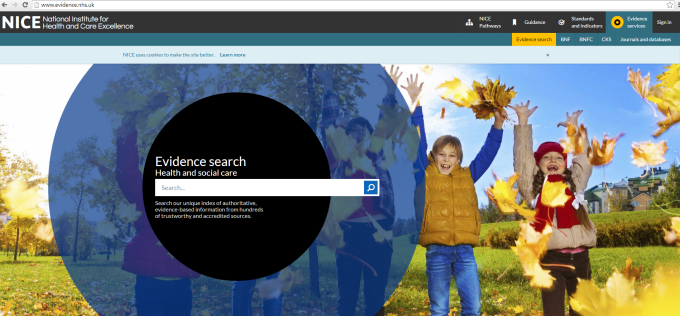
NHS Evidence 2015 screen shot

A screen grab of the 2015 revision of NHS Evidence

There has been a significant update to the main portal for NHS staff seeking the evidence for patient care.  The vast majority of the site is freely available to anyone in the UK so it is applicable to both NHS and student / academic users.

NHS Evidence has a snazzy new (fully responsively designed) look.  The giant eye ball is no longer quite so prominent (the extent to which it looks like a liquorice allsort has increased) but the changes are much more than cosmetic.

The main search box (Evidence Search) has been revamped with the promise of speedier time to answer and enhanced results.  I think it succeeds in this.  Filters have been improved to help people narrow their search and the interaction is certainly less faffy than before.  The old topic pages have disappeared but many searches will return handy context specific materials in the right hand column.

These offer things like information on medications from the British National Formulary (BNF), Clinical Knowledge Summaries and NICE guidance arranged by patient pathway.  NICE Pathways is a brilliant distillation of some times unwieldy NICE Guidance into manageable chunks linked to the progress of a patient through their care.  This gets appreciative noises from all the people I have shown it to.

The BNF access is login free which is a boon as the old BNF site has switched to needing the login prompting grumblings from @BenGoldacre amongst others.

A small number of people may be annoyed by the loss of the MyEvidence section.  This allowed people to save searches on Evidence Search and links to documents.  It has been withdrawn pending a revised offer.  I am not sure too many people will be affected (unlike the upcoming saved search issues with HDAS)

The NHS Journals and Databases page looks a bit smarter and can be accessed from the tool bar on all the pages of the NICE website.

Generally I think this is a good enhancement.  I hope this done there will now be a bit of capacity to develop HDAS.

Journal clubbing

The latest paper discussed in our team journal club took a bit of a kicking.

The Library Student Liaison Program at Eastern Washington University: A Model for Student Engagement

This paper covers a project where a student was paid to become a student liaison working directly for the Library.  They worked 15  to 19 hours a week during term time reporting directly to a fairly senior member of Library staff. They were set three main goals – enhance communication with the student body, articulate student perspectives / determine priorities to meet student needs and increase student participation in library programmes.

In common with the paper about the Library street teams (discussed last time) the paper tells us about what they did but falls down on the evaluation.  There are few attempts to address how the programme will be evaluated and where figures are provided they are frequently partial. For example we have no context to claims of an improvement in the affect score on Libqual+.  Changes to enquiry levels are discussed but without absolute figures.

In critical appraisal terms it falls at the first hurdle with a focussed research question lacking.  Like much LIS research we get a case study approach.  Applicability of the model proposed is quite limited locally with a very different institution involved and large sums of money required (at least $5K in pay for student at 2006 prices).  The commitment of staff time to managing the role was also substantial.

On the positive side we can see many of the initiatives that were proposed or introduced correspond to work we have in place or under consideration / development.  It also prompted lots of discussion of various paths for student engagement and ways to gain the student perspective.

So not a paper to change our practice but plenty to stimulate debate (and a nice blast from the past with them proudly reporting making 192 friends on MySpace).

Update catchup July 2014

It cannot be said that I am catching up at present. This issue was read before Christmas and has now travelled across London numerous times in my bag. Onwards…

JournalClick looks like an interesting developing tool. The prices for libraries are very low. Almost worryingly so and I wonder how the coverage compares to other tools. Nearly a million articles added since last July.

There is a puff from the RCN for their journal changes. Time will tell if they can find a sensible pricing model for these.

60 seconds is with Gary Birkenhead in the run up to HLG conference – here is hoping someone will step up for the role of HLG Chair as he vacates it. A really excellent opportunity for someone having had the pleasure of doing it myself a few years back.

The article on wikipedia is a nudge to actually making a few edits myself something I have long meant to try out. Cilip in London organised an evening event on the development of reference in the digital age. The best question came after what can only be described as a chest butting session amongst the audience about who knew the most about reference books / counted the most obscure one as the most vital / glories past and tales of written corrections sent to editors. “Who edits the thing?” My suggestion was – the kind of people who send corrections to the editors of reference books.

KCL colleagues feature next talking about how they have benefited from formal teaching qualifications. I have benefited from their experience without felkng compeled to pursue that path myself as yet. Shadowing their sessions it is clear that they are well structured to support learning.

The next article covers 7 tips for health website managers (though all are generally applicable). I have to look after a number of pages and this was useful when looking again at my content. Always more work to be done here – the challenge is to break free of the confines of the CMS.

The Hometrack website is one I know from mooching about property online (is this now one of the top UK hobbies I wonder?). The main thing I took from this is that most mortgage valuations are done by someone driving past and looking at the property – how on earth do they get away with charging so much!

Hello 2015

So I had grand plans to kick off 2015 at a fast pace cracking on with all sorts of plans.  Then I caught some sort of lurgy and basically conked out.  Now that I am recovered it is time to make a start. So plans…

I enjoyed popping things on this blog so that will continue.

I will carry on with the catch up on the ClLIP Update backlog (I have one in my bag that I read before Christmas still awaiting thoughts here).  I plan to expand on this by looking closely at an article from each issue of HILJ and hopefully getting some conversation going around this.

After the successful revalidation for my 2013 CPD I will repeat the process for 2014.  As part of this I want to complete the PKSB.

I am looking forward to running a couple of workshops at the UKSG Conference.

I will have my first written exam for some time for the AKC and need to get serious on the reading front for this.

I want to work out a potential writing project but not going to commit myself publicly on this at present.

That seems enough to be getting on with!

Improve critical appraisal with this one crazy tip

I spend lots of time training on basic critical appraisal.  I will have run 20 sessions over the past year (I have one more to do this morning before things grind to a halt for Christmas). This is great as they are challenging sessions where I regularly learn new things.  The quick turn over means I can also tweak as I go.

A couple of weeks ago I ran three sessions in as many days and these reinforced a few things.  It also seems timely to think about this as I have had confirmation that I will be attending this weekend long course in March.

I have had to run some of these sessions in constrained time slots (about an hour). In practice this means there is no time for the practical group appraisal exercise which is a shame.  However it also made me really focus on my slides.  A cut down version does away with nearly all the stuff about what the different research methods are and how they are used.  I found this seems to make for a more useful session – we can really focus on what people need to be doing as they read.  For many (most?) attendees the methodology stuff is a low level rehash and their interest is low.  There also isn’t enough time to do much justice to the topic even in a full two hour session. So a refreshed slide deck in prospect for next year.

Another lesson was that I should vary my papers.  I think there is a tendency in this type of training to stick to familiar favourites.  It makes for less preparation and you have the benefit of having heard others observations.  However I think one of the more successful aspects of the course is having experience of a wide range of papers to illustrate the points.  Carrying out more appraisal helps build skills and should make for a more engaging presentation.  Plus it means less repeating anecdotes.

The one crazy tip?  Running a session for a group of palliative care medics one observed:

The last sentence of the introduction is nearly always the research question


Tongue tie and the supplementary concepts

Delivering tailored literature search training for a departmental group is always a great opportunity for learning new things.  Today I helped a multiprofessional group who work in a tongue tie clinic.

This is the (cleaned up) strategy we ended up creating as part of the session:

  1. MEDLINE; (tongue AND tie).ti,ab; 160 results.
  2. MEDLINE; tonguetie.ti,ab; 6 results.
  3. MEDLINE; ankyloglossia.ti,ab; 290 results.
  4. MEDLINE; “tongue tie”.ti,ab; 157 results.
  5. MEDLINE; 1 OR 2 OR 3 OR 4; 398 results.
  6. MEDLINE; breastfeeding.ti,ab; 14979 results.
  7. MEDLINE; (breast AND feeding).ti,ab; 14567 results.
  8. MEDLINE; 6 OR 7; 27717 results.
  9. MEDLINE; MOUTH ABNORMALITIES/; 1038 results.
  10. MEDLINE; BREAST FEEDING/; 27307 results.
  11. MEDLINE; 5 OR 9; 1383 results.
  12. MEDLINE; 8 OR 10; 38085 results.
  13. MEDLINE; 11 AND 12; 109 results.

The keywords are a nice example with some extra results by dropping the space and a solid alternate term in ankyloglossia that has a big impact on total results.

More interesting again is moving to the suject headings.  There is no Tongue Tie/ and it is not immediately clear what to go to from the alternatives offered up.  When in doubt try Pubmed and a tongue tie search in Pubmed returns the following search:

“Ankyloglossia”[Supplementary Concept] OR “Ankyloglossia”[All Fields] OR “tongue tie”[All Fields]

I had not met Supplementary Concept before (or if I have I forget).  When in doubt Google and that brough me to Mesh Record Types which explains these are for chemicals, drugs and rare diseases. Each is linked to a broader descriptor by the Heading Mapped to field (HM).

Sadly HDAS does not include HM in the “more fields” option and I cannot see a likely candidate in the list I tried HW but that came up blank.

For the purposes of my session I used the MeSH browser to look it up and found

Heading Mapped to *Mouth Abnormalities

I did not note the * at the time and wonder if I should have restricted to major terms but given the small numbers of articles involved I think it was fair to go with the whole heading.

Finally I also had a look in Cochrane where there is a protocol Frenotomy for tonguetie in newborn infants (which does not come up if your search for ankyloglossia incidentally). The protocol claims there is Tongue Tie in MeSH – it is an Entry Term but it won’t map to it so not sure myself.

Welcome anyones ideas on how to explain this to people!