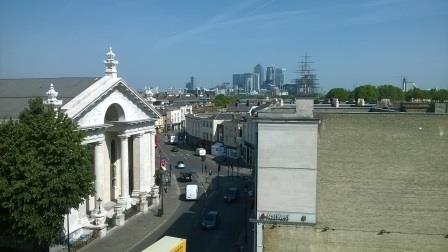
Plane takes off

An UHMLG summer trip away – day 1

This was my first attendance at an UHMLG event (the summer residential conference) and it was great to meet new people and catch up with familiar faces.  Sadly we only got as far away as Luton but the hotel was comfortable and you got used to the plane noise.

The theme was “influencing, inspiring, leading: reflections on personal and professional impact”.

We opened with Jane Savidge talking about use of leadership circles.  These are grounded in the Nancy Klein thinking environment from “Time to think”.  I read this a while ago hoping it would help me find ways to lift my thinking beyond immediate pressing issues.  In practice it is very much about listening and good questions.

Leadership circles (8 to 10 people) are aiming to break down silos and the gap between academic culture and professional services. In their aim to encourage deep thinking they do correspond more to what I had hoped for.
It sounds like it has been successful for forming relationships. It has also influenced more widely how meetings are being run throughout the university – you can see the people who are involved. The circles were related back to the 7 Habits idea of circles of influence – these have been expanded.
Anthea Sutton followed with “Librarian as leader: skills, competencies & development opportunities in library and info profession”
This was based on original research for NLH back in 2008 (later published in HILJ) and updated for a talk at the recent EAHIL conference.
Andrea contrasted her own leadership journey where she has risen (in her view accidentally) into a management position over her time at ScHARR. Management not synonymous with leadership but management can go in hand with it.  On the other hand she offered her colleague – Andy Tattersall. Andy is a specialist in electronic networks, communications. Has influence in the organisation and beyond. Very good at monitoring future trends. Leadership through expertise.
Literature says leadership is hard to define. Is one profile appropriate for our profession anyway?  A magic check list is not possible, there is no single profile, leadership courses are not Fairy dust (Greenhalgh).
Current opportunities – formal programmes (CILIP leadership thing). Your institution may be running them. Leadership MOOCs, mentoring / coaching, observation, peer support / networking, reading, writing / publishing.  360 degree feedback highly recommended – something I have always tended to dodge.  We are not good at assessing our own competence. Something to think about as (hopefully) more people engage with the PKSB.
After tea we were treated to a talk by Roisin Gwyer on influencing up.  I took limited notes as I was focussed on listening.  Starting with Yukl influence tactics we had a tour of a range of models and theories but the value for me came from the experience shared. I loved the ideas around being opportunistic – we are going to need to say things twenty times to get ideas accepted.  Having an acceptable compromise position ready in advance is something I need to do more of. Hopefully the slides will go on the UHLMG site.
The last couple of segments were a round table that worked moderately and then an update on Knowledge for Healthcare. Great to see this progressing – and I am now getting more actively involved in the national programme through Chairing a task and finish group on Metrics (get in touch anyone with strong views!).
After the group AGM we were whisked off for a BBQ at the rather lovely Offley Place.
Update catch up October 2014

You know the score – still not really catching up with these.

Useful article by Phil Bradley on net neutrality particularly in the light of recent undermining of this in Europe.

Good to hear from @AgentK23 on her trip to the m-libraries conference in Hong Kong. Discussion of WhatsApp usage reflects my experience that it is increasingly being used for group communication by medics. Another case of being where the users are perhaps?

The discussion of her event amplification through live tweeting is a good reminder to the non tweeps of what people are up to when they are tapping away. You still get some anti tweeting / mobile feeling from time to time at conferences.  Great when this is done well – I was sat near @ilk21 at the recent UHMLG Summer Conference (post to follow) and she is great at adding value to what is being said.

Another article on RDA that I dutifully read but cannot say I understood.

I particularly enjoyed the report by Charles Inskip from Digital Libraries 2014. I do not recall seeing much about this at the time and the article really sets the talks in context. Paper books for long term preservation of records!

With the Radical Librarians having gathered in Huddersfield lately I picked out the report of Dave Greene from EFF talking at IFLA.  I like his idea of libraries providing secure private internet connections as part of a wider role for protecting privacy of access to information.


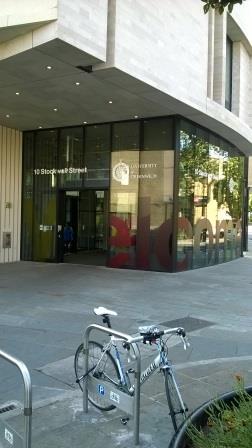
A visit to Stockwell Street

I recently had the opportunity to tour the University of Greenwich Library on Stockwell Street.  It is always interesting to have a poke around someones library – particularly when it is a shiny new one like this (opened September 2014).  I am also involved in lots of discussions about future library spaces at work so it was very helpful to see some of the new style fixtures in operation.

Library Entrance

Library Entrance

seats

Tucked in seating

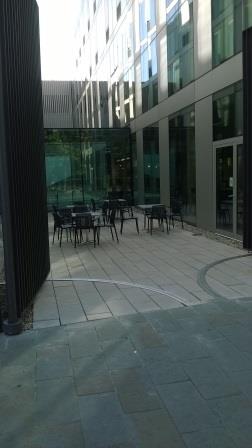
I was a bit grumpy when I realised that the Library had been built on what was my favourite market in Greenwich. The small consolation is that they were going to build flats on it otherwise.  The entrance is rather nice with a general reception before you reach the library gates.


library lobby

Lobby area


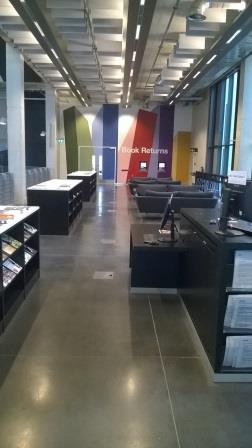
There is plenty of open space on the ground floor.

To the right of this shot is a single person desk for directions and to support use of the self issue kiosks.  The white units hold a few paper titles (architecture students use this site amongst others) and have new books displayed on top.

The interior is all brushed steel and polished concrete with predictable results – note the ceiling mounted baffles.

There are lots of different kinds of seating.  Those below faced the chairs outside and have power and data sockets concealed underneath which is neat but probably not the most convenient.

seats

Bar style seating

stairs

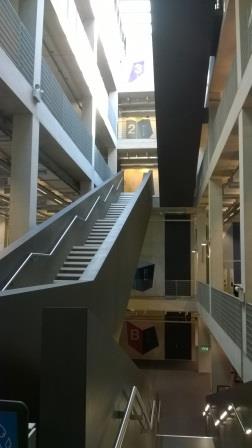
Central giant stair case

A set of enormous stairs run through the centre of the building.

Library interior

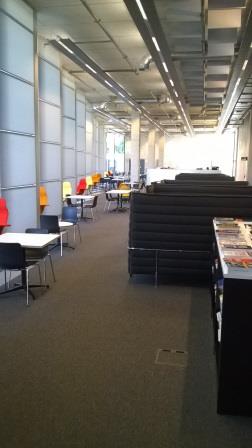
Social working space

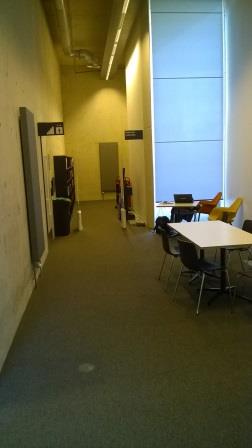
On the other side of the stairs is this rather nice space with a variety of work environments.  The grey soafs on the right face each other over coffee tables providing space for around six people to work together.  The bright chairs are each by a tall window looking outside.

Shelves

Short loan corner

Short loan is back the other way with self issue inside the gate to control access.

Laptops

Laptop trolley

Print areas are divided from the rest of the library by mid height walls.  This one down past the big grey sofas housed loan laptops for use in the Library.  I like this idea as it provides flexible access which would be inclusive to all the users of our libraries.

sofas

Loads of sofa pods


PCs

Looks familiar


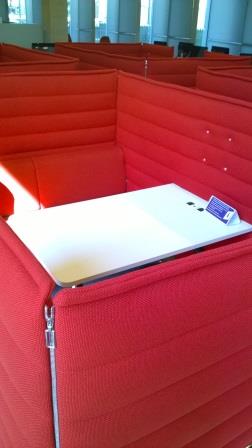
There are clusters of group work oriented sofa pods with high backs to provided some privacy and contain noise.

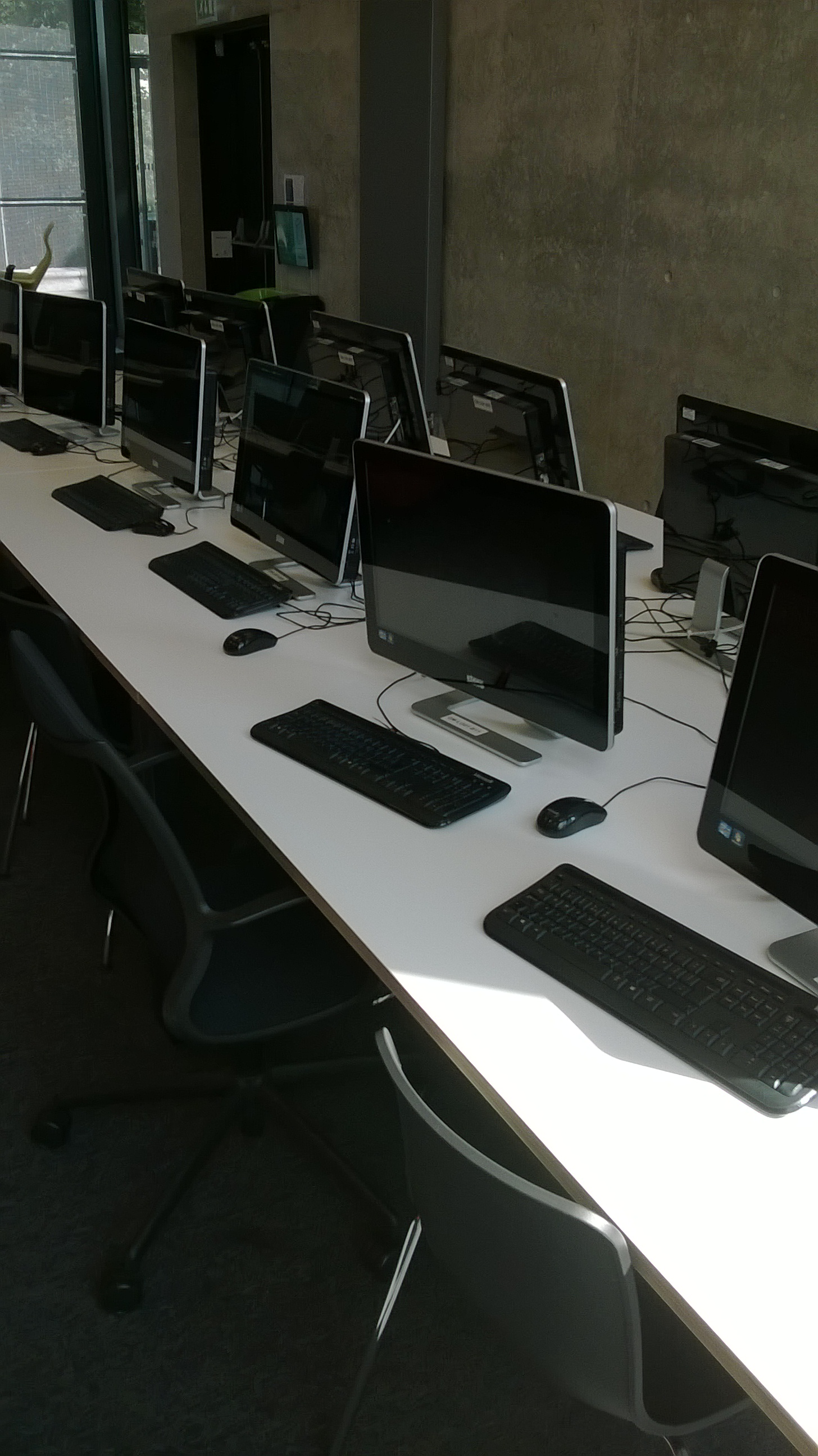
The fixed PCs are generally quite closely packed which is similar to the arrangements we have in place.  It would be nice to be able to offer more space for peoples stuff around PCs.


desk

Enquiry drum


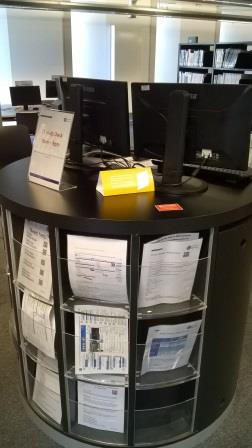
Wandering down into the basement we passed an enquiry point.  These are located around the library rather than having a single desk near the entrance.  Help leaflets are integrated into the furniture.  Not pictured are the archives who are located in the basement with some very fancy rolling stack.

chair

Wheely chair desk thing


shelves

Black shelves

library

Daylight into the basement


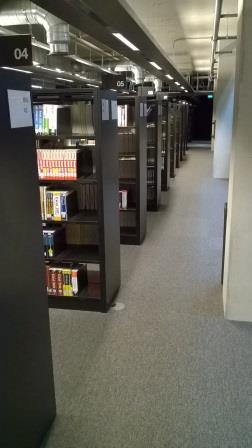
Shelving is generally not too high and slinky black.  The dark space in the distance of the left hand picture was in eco motion sensitive lights out mode (it was early when I visited).  There are clusters of desks and PCs scattered around.

training room

Laptops an option in training room

Training room

Looking from the trainers point of view

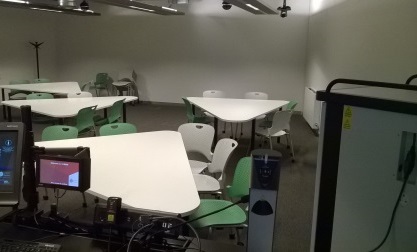
The training room is highly flexible with all furniture on wheels and capable of multiple layouts. This struck me as a really good idea.  Laptops allow the use of the space for hands on training though there would obviously be an overhead in set up time.

note the double screen

IT Enquiry Drum

IT have enquiry points too (note the double screen ahem).

PC

Standing PC for express use


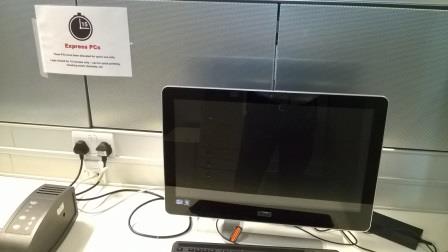
Printing areas have PCs to allow people to hop on to print something off which is a nice touch.


water fountain

Double water


giant printer

Self serve poster plotters

There are plenty of water points along with toilet facilities.

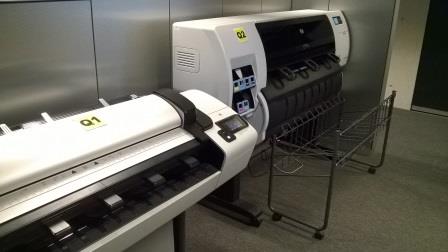
The needs of the architecture students mean that poster printers are self serve and very economical.


Sofa

Sofa pod for one to ones with students

The main staff office is on the top floor (plus some palatial quarters behind the book sorter down stairs).

office

Wide open office


We finished our tour at the staff meeting room which has a rather nice view.  I was impressed with the range of study environments in the library (not pictured are some group study rooms).  The library has a number of roof top gardens with some open for library users.  Thanks to UoG colleagues for the welcome!

Greenwich view

Not a bad view

Update catchup August 2014

Slightly scared that I am falling yet further behind with these!

The August 2014 issue has a beautiful image on the front from the National Fairground Archive and has probably travelled as many miles in my bag as many a travelling fair. I loved the article on this collection. It sits far from the things I am involved in professionally but I am always pleased to read about such a fascinating cultural treasures.

This issue has a report from HLG Conference which took place in sweltering heat in Oxford. I really enjoyed the conference offering up a version of my paper given in updated form at UKSG.  I also spoke as part of the CILIP Debate programme. There is a nice picture of me chatting with Donald Mackay at the end (and a great boggled eye one in the Dropbox collection for the conference.  I was on the losing side but this was no surprise since I had to advocate for hiring nurses using precious library funding. I gave a rather silly talk full of ill informed comment on the merits of the internet and the low level of need for our skills (not like librarians are the angels of the NHS eh?).  But I was very serious on the point that unless we act to defend our services they will get whittled away in a semi random fashion.

The article on tri-borough in London public libraries is interesting as a picture of one route forward for making the cuts that will face many services. I wonder how far such arrangements can extend – what is the most effective scale for a PL network? It is also interesting to read what @wylie_alan had to say about it after attending a CILIP in London event a couple of years back. Some things look like they could end up a bit thin – a public health officer for one borough is now spoken of as one for the tri-borough. Could be a bit busy! That said I am not sure the shift of Public Health from the NHS to local government has seen library provision survive very well.

The merger of Careers Development Group into the CILIP Branches to form Regional Members Networks seems a reasonable plan overall to me. That said I bumped into a member of the Cilip London RMN on the tube today (small place London) and it sounds like the committee is almost unchanged from when I was a member a couple of years back. A number of that committee have done very long service and I had hoped that the merger might prompt a renewal with fresh blood. Maximum terms of membership are supposed to be in place and I hope people will move aside to allow others to have a go.

Reading about Midlothian libraries I was struck by how similar our issues are in terms of needing to influence decision makers. A steady stream of data and stories is required to help people outside our world understand what we are busily up to.  The need for partners is also familiar. I was somewhat dismayed by the fact that the service is so short staffed that people are working through their holidays and in their own time.  This is simply not a sustainable way for people to live and for a service to operate.

Revalidation submission celebratory post

With only a slight hiccup due to my previous submission not having been marked as passed (rapidly rectified by Member Services) I have finally got round to submitting my CILIP Revalidation based on 2014 CPD activity.

It was great to take the time to reflect on a fairly hectic year. HLG conference was a highlight. I also felt the journal club I ran with colleagues at work was an excellent way to learn.

I was surprised quite how many libraries I visited in my travels.

I have not had a chance to join one of the seminars on obligatory revalidation but I am happy that it is a useful process for me.

This years celebratory tune from MJ Hibbett (minus the (re)validators) is a cover of Boom Shake the Room – enjoy!

UKSG Glasgow reflections

This was my first attendance at the UKSG conference. Having mostly been focussed on health information and NHS needs (and with an NHS training budget) I tended to focus my conference attendance on HLG.  I was lucky enough to be able to take my talk on extending ejournals to the NHS for a last outing (slides above) and brilliantly this meant UKSG covered my conference fees, hotel and train ticket. If I ever come up with anything that would fit with UKSG interests again I would submit again for that reason alone!
What interests UKSG was one of the questions I came away with. The range of talks was very wide encompassing apps, open access, open data, copyright, discovery, ethnography and other letters of the alphabet (search UKSG for talk recordings). While I was interested in many of the things I attended they often felt less practical than the average HLG talk. This perhaps reflected the high level of a number of speakers or the very particular specifics of their examples. It almost certainly reflects my ongoing health focus. The open access side was probably the most interesting for building my knowledge.  I did not have any great moments of revelation.
My favourite session was on ethnographic approaches. This an area increasingly in the spotlight and a likely candidate for my next years objectives. It was great to hear about the progress of research by @librarygirlknit and @llordllama (and a big pleasure to have met both of them IRL for the first time). I need to think about how to use these approaches to understand activity away from the library.
The HEFCE review of metrics sounds like it should be a good read but sadly won’t see the light of day till after the election. I enjoyed the presentation on efforts at Faber to make money from digital outside of the sale of ebooks. Having been tempted into buying one of their beautiful editions recently I had been impressed by their website. The model seems to be one of building loyalty and a community of a sort around both their core products but also desirable crafted items. There was some commentary for and against this fetishisation of the book on social media. I think it seems a good way to go – the basic edition remains available and the objects created are useful and beautiful passing the William Morris test.
I was pleased with how my sessions went. Both times there were a good number of people and some really interesting discussion was prompted. Having to spell out a lot of the NHS jargon meant there was no problem timing wise. It took about twice as long as at HLG to deliver a similar volume of material! It was also great to have the chance to talk to lots of publishers about licence extensions. Hopefully a few of these discussions will bear fruit.
The conference itself was very slickly organised (even the wifi worked OK). The social programme was fun though I tapped out early from the Ceilidh. No MD20/20 was served and no Teenage Fanclub played (to my knowledge).


Critical Appraisal – learning from the experts

I was recently lucky enough to spend a weekend locked in a hotel learning about critical appraisal at a two day workshop run by the Critical Appraisal Company.  The plan was to build my knowledge while picking up tips from expert tutors.

Like all good NHS activity it started early both days and had fairly average coffee.  The venue was smart enough and we were well fed.  With the shorter events I run timing is definitely important in terms of fitting in to available slots.  I wonder if anyone has systematically assessed which times of day are best for scheduling sessions aimed at NHS staff?  While I do not offer food and drink at my courses we do need to think about these sort of hygiene factors – how do we minimise barriers to taking the opportunity to learn?

Ahead of the course (from when we paid and for six months afterwards) we were issued with a login for elearning materials – you can see the contents list (they also sell access to these without the face to face training session). We were strongly encouraged to complete these ahead of time and they added hugely to the value of the session in my view.  The elearning takes the form of narrated slides with accompanying handouts.  The tutor on the course mentioned that these will be updated soon but I found them steady and clear.  You can jump from section to section and replay tricky bits.  Something similar would be a great addition to the brief courses I run both for learning before and after (or without any input).  Even in a two day sessions some sections went by very quickly and knowing I could review things later was a great reassurance.

On arrival we were issued with some very slick handouts.  There was a workbook that had examples, exercises and reminders of major points.  Alongside this was a tricky to physically handle A3 book. This consisted of a series of full papers from journals with appropriate IP permissions.  The paper was printed down the middle of the page with boxes either side for practical exercises aimed at pulling out aspects of the paper, checking calculations and building skills.  Finally there was a copy of the new edition of the book (Doctor’s guide to critical appraisal – a buy recommendation from me) by the course tutor (and partner).  Throughout the materials there was cross referencing to the relevant sections of the book and of the elearning.  All in all this was a very slick and integrated set of materials.

The content of the course was very similar to the elearning.  The big difference was the additional degree of elaboration and the use of anecdotes to make it less dry. This was very much in line with the way I try and present similar material. Extensive use was made of clickers to add interactivity and test understanding.  I think this was perhaps a little over done as we ended up running well behind schedule which impacted negatively on the time spent on aspects later in the agenda.  It was interesting to see the extent to which people were still not grasping key concepts. The clickers provided a non threatening way to explain where people were going wrong and bring out helpful illustrations of various learning points. I know colleagues have had some success with online polls and it merits further thought.

With the full weekend to work with the session did include much of the methodological background that I have largely dropped from my sessions.  I could see it was helpful for people but I think elearning and other options will be a better way to cover this in a tighter time scale. The explanation of randomisation techniques was helpful as this was an area I know less well and it may be something that warrants more attention than most librarians slides I have seen tend to give it.

We spent a lot of time looking at two by two contingency tables and this is something I will be adding into my sessions.  At present I cover various CER, EER, ARR, RRR, NNT calculations using an example and point to information on the table method in a handout but I think this is an oversight. So much power is made available to people to check results and I think it warrants some time.

Generally I came away feeling happy about the quality of the sessions I run. I focus hard on the practical application of appraisal – why something matters with a bit less detail about what it is. The course is excellent and I would recommend it for people looking to build their skills. Librarians who have revised their subject should have no concerns about running introductory sessions.  My impression is that librarians attend a lot more trainer the trainer sessions on critical appraisal than they deliver. People should take the plunge!

Obligatory CILIP revalidation and the change to make it worthwhile

A really important change is being proposed by CILIP to revalidation.  2015 is going to see discussions culminating in a member ballot (October) proposing that Revalidation become obligatory for those with Certification, Chartership or Fellowship.  Read all about it and then come back.

I was confused at first skim as to what the point was – obligatory but non compulsory Revalidation would make little difference.  The new scheme for Revalidation is in my view a good thing (see We (re)validate for my take) but many have shrugged or not looked too closely expecting something highly onerous / pointless. I didn’t see how the change to obligatory Revalidation would alter this.

But then someone pointed out the inclusion of a public Register of Practitioners.  This makes it a useful change.

The Register will give people a way to have the professional body confirm to anyone that they are in membership and actively engaged in CPD.  It will definitely encourage people to have a closer look at Revalidation (and hopefully give it a try).  It has the knock on effect of stopping people claiming membership levels they do not hold when applying for things.

I have been proposing something like this in all the many CILIP consultations of recent years so it is great to see it potentially coming into place.  I would like something that went further – providing an online location for sharing professional roles and activity.  Sort of like a LinkedIn profile but without it the spam and being spotted doing “library” good (thanks to the 15 people who have endorsed me for this to date!).  But this is would be a great start.

I look forward to the debate!

Journal clubbing

The latest paper discussed in our team journal club took a bit of a kicking.

The Library Student Liaison Program at Eastern Washington University: A Model for Student Engagement

This paper covers a project where a student was paid to become a student liaison working directly for the Library.  They worked 15  to 19 hours a week during term time reporting directly to a fairly senior member of Library staff. They were set three main goals – enhance communication with the student body, articulate student perspectives / determine priorities to meet student needs and increase student participation in library programmes.

In common with the paper about the Library street teams (discussed last time) the paper tells us about what they did but falls down on the evaluation.  There are few attempts to address how the programme will be evaluated and where figures are provided they are frequently partial. For example we have no context to claims of an improvement in the affect score on Libqual+.  Changes to enquiry levels are discussed but without absolute figures.

In critical appraisal terms it falls at the first hurdle with a focussed research question lacking.  Like much LIS research we get a case study approach.  Applicability of the model proposed is quite limited locally with a very different institution involved and large sums of money required (at least $5K in pay for student at 2006 prices).  The commitment of staff time to managing the role was also substantial.

On the positive side we can see many of the initiatives that were proposed or introduced correspond to work we have in place or under consideration / development.  It also prompted lots of discussion of various paths for student engagement and ways to gain the student perspective.

So not a paper to change our practice but plenty to stimulate debate (and a nice blast from the past with them proudly reporting making 192 friends on MySpace).

Update catchup July 2014

It cannot be said that I am catching up at present. This issue was read before Christmas and has now travelled across London numerous times in my bag. Onwards…

JournalClick looks like an interesting developing tool. The prices for libraries are very low. Almost worryingly so and I wonder how the coverage compares to other tools. Nearly a million articles added since last July.

There is a puff from the RCN for their journal changes. Time will tell if they can find a sensible pricing model for these.

60 seconds is with Gary Birkenhead in the run up to HLG conference – here is hoping someone will step up for the role of HLG Chair as he vacates it. A really excellent opportunity for someone having had the pleasure of doing it myself a few years back.

The article on wikipedia is a nudge to actually making a few edits myself something I have long meant to try out. Cilip in London organised an evening event on the development of reference in the digital age. The best question came after what can only be described as a chest butting session amongst the audience about who knew the most about reference books / counted the most obscure one as the most vital / glories past and tales of written corrections sent to editors. “Who edits the thing?” My suggestion was – the kind of people who send corrections to the editors of reference books.

KCL colleagues feature next talking about how they have benefited from formal teaching qualifications. I have benefited from their experience without felkng compeled to pursue that path myself as yet. Shadowing their sessions it is clear that they are well structured to support learning.

The next article covers 7 tips for health website managers (though all are generally applicable). I have to look after a number of pages and this was useful when looking again at my content. Always more work to be done here – the challenge is to break free of the confines of the CMS.

The Hometrack website is one I know from mooching about property online (is this now one of the top UK hobbies I wonder?). The main thing I took from this is that most mortgage valuations are done by someone driving past and looking at the property – how on earth do they get away with charging so much!