On “The Art of Statistics” by David Speigelhalter

Thanks to the vagaries of the Essex Libraries application of the Libraries Consortium interlending scheme I had to read a statistics book over Christmas (festive!) so it could be returned despite there being multiple copies of it on the shelf elsewhere. I would have been even more of a professional grump about it if the book was not the excellent “Art of statistics” by David Speigelhalter.

Being able to understand more about statistics is a skill that society at large would benefit from but that has a particular relevance for health information workers needing to support their users with appraising the research evidence. One of the things that brought me into health libraries was my enjoyment of modules on epidemiology and public health as part of my first degree. I also studied some statistics at A-level many moons ago so I started with some baseline. Many colleagues arrive in health libraries with nothing beyond memories of GCSE maths and other snippets they have picked up along the way which makes them nervous of venturing into this area. This is a shame as it is interesting stuff and provided we are not claiming to be statisticians we are in little danger.

Speigelhalter’s book is a great way for those with a little knowledge to reinforce it and for those without to build some base. My experience of facilitating sessions around critical appraisal is that what really helps is engaging examples that help people cut through their own worries about their lack of understanding of statistics. A significant number of excellent examples to work into your own practice are shared here – how might we have spotted Harold Shipman sooner? Can we predict whether someone would survive the sinking of the Titanic? Other more cheerful examples are explored but guided by these examples we are taken fairly briskly and in an accessible way through basic, and not so basic, concepts of statistics. Helpfully we find the same examples revisited later in the book with new possibilities opened up for reconsidering our questions and finding further helpful information.

We are encouraged to apply the PPDAC model in our thinking (image below but Problem, Plan, Data, Analysis, Conclusion and repeat essentially). PPDAC is a fine model for when we need to consider evaluating all manner of things. Plan is particularly useful with the text illustrating the pitfalls of people setting off without a plan and then “finding things” or modifying the plan in the light of interesting looking “findings”. A tempting path but not a statistically happy one.
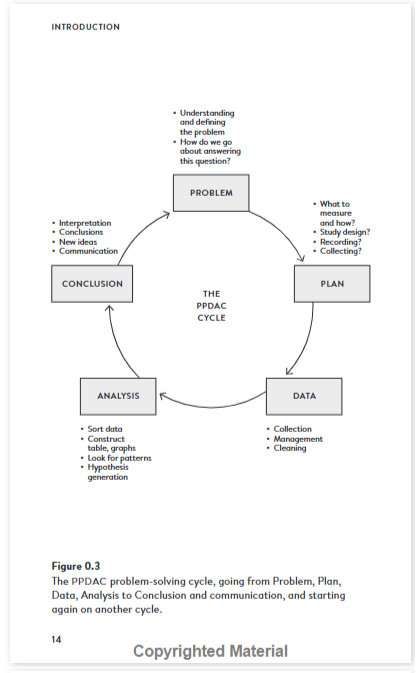
Image from the introduction of “The Art of Statistics” illustrating the PPDAC cycle

The closing chapters consider how things can go wrong and how they might be done better. They are rich with examples that will crop up in many of the papers we read.

Over at HILJ.Club I had a play recently with NotebookLM and, along with all the vocal fry in the audio podcast style summary, I was struck by how poorly the AI engaged with the statistics. Reading Speigelhalter brought back to me the importance of actually reading a paper to see all the things hidden away (and in plain sight), to get past the more or less accurate presentation in the abstract, to reflect on the sample used and all the glorious bits of bias that have found their way into the research. Stripping away this information to rapidly extract all the data tables say feels a rather risky plan.

I highly recommend this book to anyone but particularly to those who want to read research more effectively and to help others who need to do the same.
3 years of hilj.club

Time flies when you are having fun (and also sometimes when you aren’t).

A long time ago I had an idea for a way to make reading journal articles from HILJ more rewarding by encouraging discussion. You can read the back story up to the launch of hilj.club in an editorial I coauthored with Tom Roper (his blog still a good place to find him in retirement) or you can get a feel via the About page.

So – how has it gone?

Since the launch of the hilj.club website in August 2019 there have been some fairly distracting times (cough) which broke up the planned regular schedule of quarterly posts. Ignoring the hiatus from June 2020 to June 2021 we mostly got posts out. A total of 11 articles have been featured since the site was launched (following pilot posts on other platforms / venues) with a range of authors each bringing their own feel to proceedings. Most followed a reflective format but we also had a dialogue style post on a KM related article. Some tough questions have been set by the authors – not all of which got answered.

How are the numbers?

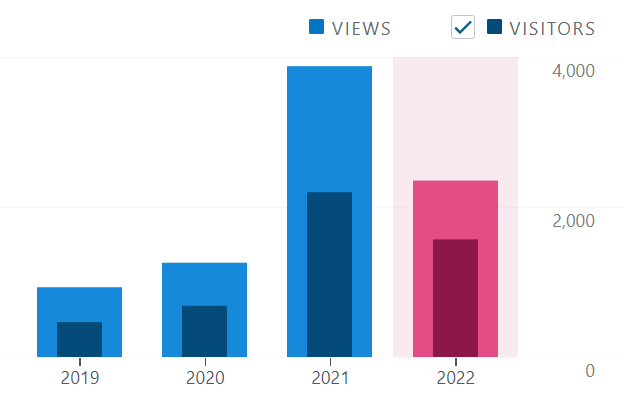
Not terrible – the web stats have risen pretty steadily (if you believe web stats). Interaction wise the idea was that people would comment on the posts or elsewhere if it suited them. Comments have never been huge and the last few posts have notably not drawn so many – perhaps a sign of the times. There is definitely evidence of impact in the downloaded article stats that are provided to the HILJ Editorial Advisory Board with a lift to articles that are featured in #HILJClub.

Is it worth it?

From my perspective #HILJClub is pretty low maintenance. I like writing the odd post and reading articles I might not otherwise off the back of peoples selections. The small team involved has stayed pretty small and chips in where they can. Authors have all had a nice little piece of CPD to log while frequently scratching an interest itch. At various times the posts have sparked debate, people have had local journal clubs off the back of them and some wrote blogposts in response to things that took their fancy. All this feels like a decent cost / benefit balance. The good news is that a number of posts are already assigned to authors so there should be another year of #HILJClub fun to follow.

Curious as to what people think might make it better / more interactive / worth their time? Answers in the comments box please (or on twitter!)

Journal clubbing – beyond saints, spies and salespeople

I had been planning to read this article on analogies for liaison roles since it came out so was pleased it was selected for my work journal club

BEYOND SAINTS, SPIES AND SALESPEOPLE: NEW ANALOGIES FOR LIBRARY LIAISON PROGRAMMES – Peter Barr and Anthea Tucker – In the Library with the Lead Pipe 19 Sep 2018

Working in a functionally aligned service it is always interesting to see how others experiences tally with ours.  Locally we have also done a great deal of work around things like Customer Service Excellence so debates around the language of the market in HE are ones we have thought about a fair bit (to the point where I spoke at an event we organised on the student as customer).  We had common experiences with the authors about needing to explain a new role within a functional model and the difficulty other departments could have in understanding this.  Looking at the website for their service it seems they retained some aspects of the traditional subject liaison role that I am not sure this was significant.  In contrast to the authors experience we did not experience a drawing away from the other functional teams.  While it has not always been easy there has been concerted work to bring teams closer together with part of the role locally specifically focussed on liaison internal to the service.

The article considers a range of analogies that have been used to help explain the role of liaison staff and suggests some other possibilities.  It was interesting to see how comfortable people were with these or not and we considered a few alternatives (the fixer perhaps).  I liked the idea of selling being not just about commercial imperatives but also “to convince of the worth of” this tallies with the strong thrust around impact and advocacy in NHS libraries.  There was a somewhat adversarial position taken that viewed sales as purely negative when there is scope for us to work with suppliers in more positive ways – they have things we want to buy and an interest in developing the use of resources (I recognise not all relationships will be positive).

I was glad the article came down ultimately to building and presenting our professional identity as librarians.  We can learn a great deal from the way other people go about their work but we should be strong in our own professional base.


HILJ CPD reading Volume 35 No 3 – Developing a generic tool to routinely measure the impact of health libraries

Welcome to the second experimental online reading group aimed at encouraging discussion of interesting articles in HILJ.  The first attempt took place around Volume 35 No 2 on CILIP Social Link (link may require CILIP login and may not take you to the right place).  Unfortunately we found SocialLink did not really offer quite what was needed so future editions will rove across any ones blog that cares to host.

I raised the possibility of having a regular discussion on articles from HILJ at HLG2018 having muttered about it for some time and as others expressed an interest (in particular Lisa Burscheidt, Morag Clarkson, Catherine Mclaren and Tom Roper) here we are.

As an HLG Member you should have access to HILJ via the link below https://archive.cilip.org.uk/health-libraries-group/health-information-libraries-journal/access-health-information-libraries-journal-hilj though many have it in a Wiley bundle and that maybe easier! The article this time is OpenAccess anyway so should be straightforward.

The idea is that an article will be selected from each issue to be discussed. The group have picked an article but there might be a vote in future or we may carry on picking a favourite by some other means (perhaps the host blogger gets to choose). The intention is to select articles with practical applications. We will offer some questions as prompts but the discussion can go where interest takes it.

The article selected this time is:

Developing a generic tool to routinely measure the impact of health libraries

Stephen Ayre, Alison Brettle, Dominic Gilroy, Douglas Knock, Rebecca Mitchelmore, Sophie Pattison, Susan Smith, Jenny Turner

Pages: 227-245 | First Published: 18 July 2018

Abstract
Background

Health libraries contribute to many activities of a health care organisation. Impact assessment needs to capture that range of contributions.

Objectives

To develop and pilot a generic impact questionnaire that: (1) could be used routinely across all English NHS libraries; (2) built on previous impact surveys; and (3) was reliable and robust.

Methods

This collaborative project involved: (1) literature search; (2) analysis of current best practice and baseline survey of use of current tools and requirements; (3) drafting and piloting the questionnaire; and (4) analysis of the results, revision and plans for roll out.

Findings

The framework selected was the International Standard Methods And Procedures For Assessing The Impact Of Libraries (ISO 16439). The baseline survey (n = 136 library managers) showed that existing tools were not used, and impact assessment was variable. The generic questionnaire developed used a Critical Incident Technique. Analysis of the findings (n = 214 health staff and students), plus comparisons with previous impact studies indicated that the questionnaire should capture the impact for all types of health libraries.

Conclusions

The collaborative project successfully piloted a generic impact questionnaire that, subject to further validation, should apply to many types of health library and information services.


I picked this article as this has been a hot topic for some time now.  I expect many of us will have experience and views on the generic impact questionnaire so there should be useful discussion.  I have not read the article before selecting it!

Starter Questions –
What? What do you think of this article / the generic impact questionnaire / etc?
So what? Does this change your view of the tool?  What changes might we want to see with the tool?
Now what? Are you going to do anything with it?

The next edition of the HILJ CPD Reading experiment (name suggestions welcome! #HILJClub perhaps?) will appear when volume 35 no 4 appears and be hosted by Lisa Burscheidt over at That Black Book.

Look forward to the discussion!  The comments box is further down in this template than I realised so do scroll down to reach it!

Journal Clubbing – Principles and practice in impact assessment for academic libraries

A change of tack at the team Journal Club with a paper on impact assessment

Christine Urquhart, (2018) “Principles and practice in impact assessment for academic libraries”, Information and Learning Science, Vol. 119 Issue: 1/2, pp.121-134, https://doi.org/10.1108/ILS-06-2017-0053

It was a different paper in that it was a literature review so was rather more general than some of the articles we have been using.

We found the idea of reciprocal value propositions worth exploring.  What happens when these go wrong?  There is a danger in both sides being willing but not always able to deliver on what they might wish for.  Opportunities for using value co-creation could also be imagined.  The idea of student reviews on the value of particular reading list choices could potentially lead to some tricky conversations but would only be providing a formal recognition of discussions that already take place amongst the students.

In many areas the literature points to the importance of strategic alignment with our organisations wider goals.  This is not revolutionary but worth trying to do well.

Discussion on the time involved in qualitative data work along with more generally on gathering and managing feedback should help us in future to more carefully frame what we are trying to achieve.  GDPR should also drive care over data collection and retention. Just because data might be available does not mean it is practically or ethically desirable to use it.

I found the referenced paper Mengel, E. and Lewis, V. (2012), “Collaborative assessment”, Library Management, Vol. 33 Nos 6/7, pp. 357364[Link] on developing a set of measures for a balanced score card particularly interesting given the difficulty of this task and passed it to relevant colleagues.

Overall we found a lot to discuss in the paper but I am not sure it worked as well as some of the research papers we have used previously.  Too often we were left with too little information without going on to read the underlying papers.


Journal Clubbing – Subject vs functional

A new round of our team journal club.  This time some reading looking at different models for delivering liaison in academic libraries.

Subject vs. functional: Should subject librarians be replaced by functional specialists in academic libraries?

Catherine Hoodless, Stephen Pinfield


Journal of Librarianship and Information Science

First Published June 15, 2016
This was a good paper for prompting discussion in our group.  Locally we are operating in a functional model so it is helpful to have a picture of practice and motivation elsewhere.
The researchers carried out semi-structured interviews with 11 senior library managers in the UK.  Opinion was divided amongst them as to which was the right path to take. Unsurprisingly their view tended to reflect whether they had undertaken a shift to a functional model or not.
The drivers for change felt familiar and prompted discussion of how important consistency was.  Subject librarians are like clinical librarians in that they are an expensive resource in limited supply with the potential to create big variations in level of service provision according to degree of involvement.  Strategic targeting of this resource is always going to be required.  The significant growth in HE over recent years is a big pressure on what sort of service can be offered to all.
The article shows evidence of how the models tend to get fudged with a continuum of activity.  Setting boundaries is a challenge in an emerging model. Role holders are generally getting to grips with a revised role rather than coming in to it fresh which must also have an impact.
As ever I found myself wanting to read more research on the effectiveness and impact of the different models.

Journal clubbing – impact of physically embedded librarianship on academic departments

After something of a gap it was good to have a return of the Journal Club at work.  The article this time was

The Impact of Physically Embedded Librarianship on Academic Departments – Erin O’TooleRebecca BarhamJo Monahan 2016 Portal: Libraries and the Academy

This was interesting for the team as a way to consider how librarians might best approach closer working with faculties and in particular whether physical collocation is important.

The article examines the impact of a shift to three liaisons being based more with their faculty following changes to the delivery of enquiry services within the library.

There is a big emphasis on counting different routes to interactions.  The picture from these figures is unconvincing.  There are a number of variables that can be controlled for.  There is little consideration of any change in the type, quality or depth of the enquiries.  This would be more useful to know – a fall in enquiries could be a positive thing if more useful enquiries are replacing them.

Given the focus on quantitative data it was also disappointing to not have any examination of data around their use of Libguides.

Generally the study would have been more interesting by including qualitative elements. There is a brief mention of chats with faculty and it would be these interactions that are interesting.

So a helpful paper from prompting discussion but not one where you can draw much that is transferable.


Journal clubbing – strategic engagement: new models of relationship management for academic librarians

My team journal club discussed the following paper this week

Strategic engagement: New models of relationship management for academic librarians

Jeanette Eldridge , Katie Fraser , Tony Simmonds , Neil Smyth . (2016) New Review of Academic Librarianship.

Very much hot off the press having been published earlier this month!

We had a highly productive discussion reflecting the paper echoing our own ongoing work on development of new models around liaison and engagement.  I found the concept of “bridging conversations” helpful as an alternative way to present what I have always thought of as the translation service I operate between HE and the NHS. The focus on senior academics and professional services colleagues was greater than in our approach and we were left wondering who does carry out the liaison that is no longer covered by the team in the article?

It would be good to have seen more robust research around the extent of engagement roles in Russell Group (and beyond) institutions.  Investigation focused on information from websites when a conversation might have been both more straightforward and useful. We do not use engagement as a term in either our team name or job titles so may have slipped through the net.

The importance of resolving ambiguities within the library about the new model chimed and prompted discussion of how we might need to continue this work locally.  Also interesting was that the model appeared to have been compromised by the subject related needs of some disciplines.  I am very aware of some of the tensions around this in health with specialist knowledge around systematic review valued by those we work with.

There would be definite value in meeting with the team at University of Nottingham to share experience.


Journal clubbing – Exploring Customer Engagement for Deeper Relationships

We had the latest round of our team journal club last week.  The paper this time was

Bettina Peacemaker & Jill Stover Heinze (2015) Moving Users, Moving
Results: Exploring Customer Engagement for Deeper Relationships, College & Undergraduate
Libraries, 22:3-4, 261-272, DOI: 10.1080/10691316.2015.1081084

This proved to be a great discussion starter.  It examines the research around customer engagement in the business literature and places this in the context of seeking to increase engagement in the academic library environment.

While the language is firmly in the “customer” model it was easy to look beyond this to the arguments being advanced about collaboration and engagement.  The model in libraries has frequently been one of “Here is the beautiful service that (as experts) we have designed for you – enjoy” followed by disappointment at uptake.  We have increased our openness to feedback for the things we provide in this way we have not always moved far from this model.  Business process management models can also drive us towards there being a right way for something to be done to match our work flows.  Are these approaches going to drive engagement and partnership?

I was interested in the idea that the experiences people have with us drive emotion that in turn fuels engagement.  Our libraries can be places of very big highs and lows – there are days where people will feel we have saved their life or ruined it.  Powerful things happen around us!

We explored how we might better work with the information we have about users and non users to better communicate with them. I heard about an interesting example in public libraries lately where they wrote to all the people who had not visibly used the service for a year saying “we miss you” and it drove a big return of uptake from the targeted group.  There is also the question of how much time we spend working with those who are already engaged versus those who are not.  Generally we need to do more with the information we already gather from activity and feedback.

A big theme of the paper is the need to cocreate services and to engage people with a view to addressing their problems rather than focussing on our own agenda.  Reading lists is a live topic at present and was highly illustrative of the potential for a different approach that might takes us forward faster in the end.

Journal clubbed

Our latest team journal club considered “The promise of academic libraries: turning outward to transform campus libraries” by Kranich, Lotts and Springs.

I picked this paper as it looks at how someone has been seeking to develop their liaison model through community engagement.  The team involved have clearly been exploring in a period of change and in some ways this paper felt like them reaffirming publicly some of the results.

We were very interested in the way they piggy backed on groups set up for other projects to have “community conversations”.  These gave space for senior staff of the institution to get together to talk about a wide range of questions across the scope of the institution.  While the links to library drivers were interesting it was the whole picture of the objectives and issues in play for the institution that was most useful.  The fruits of these discussions were then fed back to the library teams to give them a much stronger picture of the priorities and direction of travel of the university.  Similar conversation sessions were also held with library teams building internal understanding of work in progress and direction of travel.  Use was made of the ideas from the Harwood Institute and these look helpful as a framework.

Areas around impact were weaker. Some of the measures proposed sound very hard to assess with any accuracy.

Generally it was a positive paper as a statement of intent and helped drive a good discussion.